
All industries Manufacturing
Run the whole factory from one system.
Production, stock, sales, purchasing, finance and payroll in one system built around how your floor actually works. Everyone logs in once, and the numbers you make decisions on are live.
- Modules
- 16
- Features
- 220
- Login
- 1

Your factory runs on
WhatsApp.
Excel.
Job cards.
- Stock lives in three spreadsheetsNobody knows what is really in the store until someone walks over and counts.
- Orders arrive on WhatsAppThey get lost somewhere between sales, the floor and dispatch.
- Costing is a guessYou know what a batch sold for, not what it actually cost to make.
- Month end takes a weekInvoices, M-Pesa and bank statements matched by hand, line by line.
Your factory deserves better.
The system
PMS, ERP and CRM. One login.
Production, quality, maintenance, stock, purchasing, sales, dispatch, finance, HR and payroll on one database, with one approvals inbox and insights that flag trouble early. An order taken by sales reaches the floor, the store and the books without being typed twice. Click around: it is set up as a demo food plant in Ruiru.
MRMwamba Ridge FoodsFood processing, Ruiru
- Overview
- Production
- Supply chain
- Sales
- Finance & people
Dashboard
JWJanet WairimuOperations manager
WEEK 41 Welcome back, Janet
Mwamba Ridge Foods, Ruiru. Tuesday 6 October 2026.
Order bookKES 48,600,000112 open sales orders ▲ 2.2%
Cash in this weekKES 9,840,000KES 6.8M payments waiting ▲ 2.3%
Stock valueKES 38,420,0009 items below reorder ▲ 2.6%
Orders needing action73 at risk, 4 credit holds ▼ 3.3%
Order book, last 12 weeksKES 48,600,000
This periodLast period
20 Jul3 Aug17 Aug31 Aug14 Sep28 Sep
By status
- at risk2
- credit hold2
- approval1
At a glance
Orders needing attention
OrderCustomerIssueStatus
SO-26-2231
Kamau Wholesalers
Blending 2 days behind
at risk
SO-26-2233
Mlimani Traders
KES 846,000 overdue
credit hold
SO-26-2236
Ziwa Distributors
Peanut butter on QA hold
at risk
SO-26-2237
Kamau Wholesalers
Over credit limit
credit hold
SO-26-2238
Kilele Supermarkets
4% below price list
approval
No records match.
Insights this morning
Soya short in 6 days14 t needed, 6 t on hand, LPO late
SO-26-2231 likely to ship lateBlending 2 days over target
Packing crew B overloaded62 h overtime this week
Kamau Wholesalers overdueKES 486,000, 32 days
New dashboard
AI insights
JWJanet WairimuOperations manager
AI insightsRaised overnight from orders, stock, cash and people.
Open insights14 ▲ 9.5%
Act now32 orders, 1 material ▼ 1%
Value at riskKES 2,940,000 ▲ 8.1%
Resolved, 30 days26 ▼ 3.1%
Insights raised by week68
By status
- act now2
- watch3
- new1
- resolved1
All areas All status Last 7 days
InsightAreaDetailStatus
SO-26-2231 at risk
Production
KES 883,200 due Fri
act now
Soya short in 6 days
Stock vs demand
14 t needed, 6 t on hand
act now
Kamau Wholesalers overdue
Receivables
KES 486,000, 32 days
watch
Packing crew B overloaded
People
62 h overtime this week
watch
Peanut yield drifting
Production
86.9% against 88.5%
watch
Kilele is 31% of sales
Customers
Concentration risk
new
Line 4 energy up 18%
Assets
Roaster burner serviced
resolved
No records match.
Raised 6 Oct, 06:00 · Production · Owner Grace Muthoni
- Order
- SO-26-2231, Kamau Wholesalers
- Product
- Porridge flour 1 kg, 9,600 packs
- Due
- Fri 9 Oct, 16:00
- Current stage
- Blending, 2 days over its 1-day target
- Why
- Soya delivery on LPO-26-0388 is late
- Value at risk
- KES 883,200
- Suggestion
- Split: 4,800 packs Fri, 4,800 Tue
- Assigned to Grace Muthoni, planner, by Janet Wairimu
- Insight raised: blending 2 days behind target, order due in 3 days
- Supplier moved the soya delivery on LPO-26-0388 to Wed 7 Oct
- Order confirmed and production order PRD-26-0419 released
New alert rule
Approvals
JWJanet WairimuOperations manager
ApprovalsWaiting for you and your team, oldest first.
Waiting for you6 ▲ 8.2%
Value waitingKES 8,402,860 ▲ 5%
Oldest item2 days ▲ 8.5%
Approved this week48 ▲ 2.1%
All types All status Mine only
RefTypeAmountRaised byStatus
LPO-26-0392
Purchase order
KES 1,284,000
Esther Njeri
awaiting you
PAY-26-041
Supplier payment run
KES 6,842,300
Mercy Achieng
at next level
ADJ-26-0117
Stock adjustment
KES 38,400
David Kiprop
awaiting you
DSC-26-0086
Price discount, 4%
KES 92,160
Brian Mutua
awaiting you
CL-26-0041
Credit limit increase
KES 1,000,000
Brian Mutua
returned
OT-26-W40
Overtime, packing crew B
KES 148,600
Lucy Chebet
approved
BNK-26-007
Supplier bank change
No amount
Esther Njeri
at next level
LV-26-0224
Annual leave
4 days
Rose Akinyi
awaiting you
WO-26-0071
Write-off, near expiry
KES 25,200
David Kiprop
at next level
LPO-26-0390
Purchase order
KES 286,000
Esther Njeri
approved
EXP-26-0311
Expense claim, fuel
KES 12,400
Brian Mutua
approved
ADV-26-0052
Salary advance
KES 30,000
Collins Ouma
rejected
No records match.
Purchase order levels
Up to KES 250,000Head of department
Up to KES 2,000,000Operations manager
Above KES 2,000,000Managing director
Any amountThe raiser can never approve
Purchase order · Uasin Gishu Soya Growers · Raised 6 Oct, 07:50
- Items
- 24 t soya beans at KES 53,500 a tonne
- Amount
- KES 1,284,000
- Came from
- PR-26-0211 and RFQ-26-0057, 3 quotes
- Budget line
- Raw materials, 71% used in October
- Maker
- Esther Njeri, procurement
- Your level
- Level 2, up to KES 2,000,000
- After you
- Nobody: yours is the final approval
- LPO raised from the award on RFQ-26-0057 by Esther Njeri
- Lowest of 3 quotes awarded: KES 53,500 a tonne, delivery in 2 days
- Purchase request PR-26-0211 approved by Grace Muthoni
- Request raised from the reorder proposal: soya cover 6 days
Submit for approval
Production orders
JWJanet WairimuOperations manager
Production ordersOpen orders on their stage tracks, week 41.
Open orders23 ▲ 2.2%
On target176 behind a stage ▼ 0.8%
At risk3KES 2.4M of sales orders ▲ 2.8%
Output yesterday61.9 t ▲ 1%
All lines All stages This week
OrderProductStageStage daysStatus
PRD-26-0418
Maize meal 2 kg
Packing
0.5 of 1
on track
PRD-26-0419
Porridge flour 1 kg
Blending
3 of 1
at risk
PRD-26-0416
Peanut butter 400 g
QA hold
2 of 2
behind
PRD-26-0417
Fortified flour 2 kg
Milling
1 of 1.5
on track
PRD-26-0420
Maize meal 2 kg
Cleaning
0.5 of 0.5
on track
PRD-26-0415
Peanut butter 800 g
Rework
1 of 0.5
at risk
PRD-26-0414
Maize meal 1 kg
Done
4 of 4.5
closed
PRD-26-0421
Porridge flour 1 kg
Not started
0 of 1
planned
PRD-26-0422
Peanut butter 400 g
Not started
0 of 2
planned
PRD-26-0413
Fortified flour 2 kg
Done
4 of 4
closed
PRD-26-0412
Peanut butter 800 g
Done
3 of 2.5
closed
No records match.
Line 2, maize milling · Shifts A and B · Released 2 Oct 2026
- Product
- Maize meal 2 kg, recipe MM2-R4
- Made for
- Stock, and SO-26-2228 Pwani Distributors
- Stage track
- Clean, condition, mill, fortify, QA, pack
- Order days
- 3.5 of 4 allowed, due Wed 7 Oct
- Planned
- 24,000 packs, 48.0 t
- Done so far
- 15,360 packs, 30.7 t
- Yield to standard
- 99.6% (tolerance 98%)
- By-products
- Bran 5.8 t, germ 1.9 t
- Pallets 12 to 16 booked into finished goods, 7,680 packs
- QA passed: moisture 12.8%, aflatoxin 3 ppb, by Faith Wanjiru
- Card moved to packing on the kanban board, inside its target
- Milling started on Line 2, crew of Samuel Otieno
- Released from the week 40 schedule by Grace Muthoni
New production order
Recipes & BOMs
JWJanet WairimuOperations manager
Recipes & BOMsActive recipes, drafts and the yield planner.
Active recipes18 ▲ 6.3%
Drafts in review3 ▼ 1.7%
Average planned yield96.8% ▲ 5.3%
Cost change, October2.1%after the soya price rise ▲ 7.2%
Active recipes, last 12 weeks18
This periodLast period
20 Jul3 Aug17 Aug31 Aug14 Sep28 Sep
By status
- active4
- draft1
- awaiting QA1
- retired1
All lines All status
RecipeProductPlanned yieldCost per packStatus
PF1-R3
Porridge flour 1 kg
97.2%
KES 61.40
active
MM2-R4
Maize meal 2 kg
98.1%
KES 112.80
active
PF2-R1
Porridge flour 2 kg
97.0%
KES 118.60
draft
FF2-R2
Fortified flour 2 kg
97.6%
KES 121.90
active
PB4-R6
Peanut butter 400 g
88.5%
KES 168.20
active
PB4-R7
Peanut butter 400 g
89.4%
KES 165.70
awaiting QA
PF1-R2
Porridge flour 1 kg
96.4%
KES 59.10
retired
No records match.
Yield planner, 8,000 packs PF1-R3
Maize 5.76 tFrom silo 2, batch RM-2609-114
Soya 1.65 t, millet 0.82 tSoya short by 0.4 t
Expected loss 0.23 tCleaning and milling, 2.8%
334 bale bags, 8,000 pouchesPacking store has enough
Porridge flour 1 kg · Version 3 · Approved 14 Sep 2026
- Blend per tonne
- Maize 700 kg, soya 200 kg, millet 100 kg
- Premix
- Vitamin and mineral premix, 200 g a tonne
- Stages
- Clean, roast soya, mill, blend, QA, pack
- Planned yield
- 97.2% after cleaning and milling
- Packing
- 1 kg pouch, 24 pouches a bale
- Allergens
- Soya
- Cost per pack
- KES 61.40 at October prices
- Cost rolled up again after soya rose to KES 53,500 a tonne
- Version 3 approved by Peter Ndirangu, QA manager
- Millet raised from 80 kg to 100 kg a tonne, maize reduced
- Version 3 drafted from version 2 by Grace Muthoni
New recipe
Quality
JWJanet WairimuOperations manager
QualityInspections, NCRs and complaints this week.
Inspections this week142 ▲ 5.6%
First-time pass96.5% ▲ 1.4%
Open NCRs41 past its due date ▲ 3.5%
Complaints open2 ▼ 1%
Mon 5Tue 6Wed 7Thu 8Fri 9
07:0008:0009:0010:0011:0012:0013:0014:0015:0016:0017:00
All checks All status This week
InspectionBatchCheckScoreStatus
INS-26-3381
MM-261006-A
Release, maize meal
96 of 100
passed
INS-26-3382
RM-2610-031
Intake, white maize
58 of 100
rejected
INS-26-3379
PB-261005-B
Release, peanut butter
Awaiting lab
on hold
INS-26-3383
RM-2610-029
Intake, soya
92 of 100
passed
INS-26-3378
PF-261005-A
In-process, moisture
88 of 100
passed
INS-26-3376
PB-261003-A
Release, peanut butter
64 of 100
rejected
INS-26-3384
PK-2610-007
Intake, pouch film
Not started
due today
No records match.
NCRs and complaints
NCR-26-044, peanut butter oil separationRework on PRD-26-0415, due 9 Oct
NCR-26-043, maize at 14 ppb aflatoxin28 t returned to supplier
Complaint from Mlimani TradersTorn bales, batch MM-260928-B
Corrective action, packer seal jawsKevin Omondi, due 8 Oct
Release check · Maize meal 2 kg · PRD-26-0418 · 6 Oct 2026
- Batch
- MM-261006-A, 7,680 packs
- Moisture
- 12.8% (limit 13.5%)
- Aflatoxin
- 3 ppb (limit 10 ppb)
- Fortification
- Iron and zinc within specification
- Fill weight
- Average 2,008 g, none under 2,000 g
- Seal and label
- 40 packs checked, no defects
- Score
- 96 of 100, pass
- Inspector
- Faith Wanjiru, QA technician
- Batch released for sale by Peter Ndirangu, QA manager
- All checks passed, score 96 of 100
- Samples taken from pallets 1, 6 and 12
- Inspection opened from the release plan for PRD-26-0418
Record inspection
Assets & maintenance
JWJanet WairimuOperations manager
Assets & maintenanceMachines, jobs and energy, week 41.
Machine uptime97.2% ▲ 2.1%
Open jobs9 ▲ 3.9%
Planned jobs on time92% ▲ 7.5%
Energy per tonneKES 1,840 ▲ 8.2%
All lines All status
JobAssetWorkDueStatus
MJ-26-0612
Hammer mill 2
Breakdown, torn screen
Done 6 Oct
completed
MJ-26-0614
Peanut roaster
Service, 500 h
Thu 8 Oct
scheduled
MJ-26-0610
Packer, Line 2
Seal jaw wear
2 days overdue
overdue
MJ-26-0615
Generator 250 kVA
Service, 250 h
Mon 12 Oct
scheduled
MJ-26-0613
Colloid mill
Bearing noise
Today
in progress
MJ-26-0609
Platform scale 3
Calibration
Done 2 Oct
completed
MJ-26-0616
Truck KDK 412M
Service, 10,000 km
Fri 16 Oct
scheduled
MJ-26-0617
Colour sorter, Line 1
Ejector fault
Today
reported
MJ-26-0611
Bucket elevator 3
Belt tracking
Fri 9 Oct
waiting parts
MJ-26-0618
Steam boiler
Annual inspection
Wed 14 Oct
scheduled
MJ-26-0608
Air compressor
Service, 2,000 h
Done 1 Oct
completed
No records match.
Breakdown · Hammer mill 2, Line 2 · Reported 6 Oct, 06:20
- Asset
- Hammer mill 2, AST-0042, bought 2021
- Fault
- Screen torn, meal coming out too coarse
- Technician
- Kevin Omondi
- Downtime
- 1 h 40 min
- Spares
- Screen 1.2 mm, KES 18,500
- Labour
- 2.0 h, KES 1,600
- Spent in 2026
- KES 64,300 on this mill, 7 jobs
- Back in service, signed off by Samuel Otieno
- Test run passed, particle size within limits
- Screen issued from the spares store. 1 left, reorder raised
- Fault reported from the Line 2 tablet, Kevin Omondi told
New maintenance job
Inventory & batches
JWJanet WairimuOperations manager
Inventory & batchesStock by batch across the Ruiru stores and depots.
Stock valueKES 38,420,000 ▲ 2.8%
Batches in stock214 ▲ 5.4%
Below reorder level9 ▲ 9.8%
Near expiry4within 30 days ▲ 2.3%
Silos
Raw material stores
Packing store
Finished goods
Depots
MM is maize meal, PB peanut butter. Silo levels from the 05:30 dip.
All stores All status
BatchItemStoreQuantityStatus
RM-2609-114
White maize
Silo 2
8.9 t
released
RM-2610-032
Groundnuts
Intake bay
4.2 t
QA hold
PB-261005-B
Peanut butter 400 g
Finished goods
3,000 jars
QA hold
MM-261006-A
Maize meal 2 kg
Finished goods
7,680 packs
released
PK-2609-021
Pouch film 1 kg
Packing store
14 rolls
supplier owned
RM-2610-029
Soya beans
Store 1
6.0 t
released
PF-260412-A
Porridge flour 1 kg
Depot, Mombasa
420 packs
near expiry
No records match.
White maize · Silo 2 · Received 29 Sep 2026 on GRN-26-2198
- Supplier
- Kitale Grain Growers, LPO-26-0371
- Received
- 60.0 t on 29 Sep 2026
- On hand
- 8.9 t in Silo 2
- Issued to
- PRD-26-0418 and PRD-26-0420
- QA result
- Passed: moisture 12.9%, aflatoxin 4 ppb
- Cost
- KES 46,200 a tonne, moving average
- Value on hand
- KES 411,180
- Best before
- 28 Mar 2027
- 12.0 t issued to PRD-26-0420 on Line 1
- 39.1 t issued to PRD-26-0418 on Line 2
- Released by QA: moisture 12.9%, aflatoxin 4 ppb
- 60.0 t received on GRN-26-2198, QR labels printed, placed on QA hold
Adjust stock
Purchasing
JWJanet WairimuOperations manager
PurchasingRequests, orders and receipts, October 2026.
Open POs31KES 18.6M ▼ 4.6%
Awaiting delivery12 ▲ 2.6%
Unmatched bills5KES 742,000 ▲ 4.1%
GRNI over 30 daysKES 1,186,000 ▲ 6.2%
Local and import All status October
DocumentSupplierValueStageStatus
IPO-26-0014
Sunrise Nutrients
USD 18,400
Landed costs added
received
LPO-26-0388
Uasin Gishu Soya Growers
KES 749,000
Delivery due 7 Oct
late
LPO-26-0392
Uasin Gishu Soya Growers
KES 1,284,000
Awaiting approval
in progress
LPO-26-0385
Kibwezi Groundnut Traders
KES 512,400
GRN on QA hold
in progress
LPO-26-0379
PakPrint Packaging
KES 436,800
Bill KES 18,200 over
mismatch
LPO-26-0371
Kitale Grain Growers
KES 2,772,000
Matched and paid
received
RFQ-26-0058
3 spares suppliers
About KES 380,000
2 of 3 quotes in
in progress
PR-26-0144
Not chosen yet
About KES 64,000
Bearings and belts
requested
LPO-26-0390
PakPrint Packaging
KES 286,000
Due 12 Oct
sent
LPO-26-0393
Ruiru Fuel Centre
KES 182,400
Due 8 Oct
sent
LPO-26-0380
Kitale Grain Growers
KES 1,386,000
GRN-26-2203 posted
received
No records match.
Request to payment, LPO-26-0371
PR-26-0198 approved24 Sep, maize cover at 9 days
RFQ-26-0044 awarded25 Sep, lowest of 4 quotes
GRN-26-2198, 60.0 t29 Sep, passed QA 30 Sep
Bill matched and paid2 Oct, Equity Bank run PAY-26-039
Import order · Fortificant premix · Arrived 1 Oct 2026
- Supplier
- Sunrise Nutrients, India
- Items
- 1,600 kg premix in 25 kg drums
- Order value
- USD 18,400 at KES 129.20
- Freight and insurance
- KES 286,000
- Duty and clearing
- KES 214,600
- Landed cost
- KES 2,877,880, KES 1,798.68 a kg
- GRN
- GRN-26-2207, passed QA on 2 Oct
- Bill
- Matched to PO and GRN, due 31 Oct
- Bill matched three ways and released for a payment run
- Clearing agent and duty invoices added as landed costs
- Received on GRN-26-2207 and held for QA
- Shipped, bill of lading and packing list attached
- Import order approved by Joseph Kariuki, managing director
New purchase request
Suppliers
JWJanet WairimuOperations manager
SuppliersCompliance and performance, October 2026.
Active suppliers64 ▲ 1.8%
Documents expiring5in the next 30 days ▲ 3.7%
On-time deliveries91% ▲ 7.1%
Bank changes pending1 ▲ 3.9%
On-time deliveries by week, %358%
By status
- approved3
- under review2
- expiring1
- blocked1
All categories All status
SupplierCategoryScoreDocumentsStatus
Kitale Grain Growers
Maize
94 of 100
All valid
approved
Uasin Gishu Soya Growers
Soya
78 of 100
All valid
under review
Kibwezi Groundnut Traders
Groundnuts
83 of 100
Bank change pending
under review
PakPrint Packaging
Packing
88 of 100
TCC expires 20 Oct
expiring
Sunrise Nutrients
Premix, import
90 of 100
All valid
approved
Thika Road Hardware
Spares
72 of 100
TCC expired 1 Oct
blocked
Ruiru Fuel Centre
Fuel
95 of 100
All valid
approved
No records match.
Maize supplier since 2023 · KRA PIN P051****21K · Kitale
- Contact
- Wilson Barasa, 0722 *** 318
- Terms
- 30 days, in KES
- Bank account
- Verified by call-back, 12 Sep 2026
- Documents
- TCC to Mar 2027, licence to Jun 2027
- On time, 6 months
- 18 of 19 deliveries
- Rejections
- 1 load of 19, aflatoxin
- Spend this year
- KES 41,860,000
- Score
- 94 of 100, 2nd of 9 maize suppliers
- September scorecard: 94 of 100, up from 91
- 60.0 t delivered on LPO-26-0371 and passed QA
- Tax compliance certificate to March 2027 uploaded on the portal
- Bank account change verified by call-back and approved by Paul Gitau
Add supplier
Customers & quotes
JWJanet WairimuOperations manager
Customers & quotesQuotes out and customers on credit, October.
Quotes outKES 9,460,000 ▲ 6.6%
Win rate, 90 days58% ▼ 4.9%
Active customers146 ▲ 1.3%
Broker commission dueKES 186,400 ▼ 3.4%
All reps All status Last 30 days
QuoteCustomerValueLast activityStatus
QT-26-0512
Ziwa Distributors
KES 1,744,800
Accepted 2 Oct
accepted
QT-26-0515
Kilele Supermarkets
KES 2,268,000
Viewed 6 Oct
sent
QT-26-0516
Neema Institutional Supply
KES 864,000
Sent 5 Oct
sent
QT-26-0509
Mlimani Traders
KES 1,108,800
No reply in 8 days
follow up
QT-26-0507
Pwani Distributors
KES 3,014,400
Order SO-26-2228
accepted
QT-26-0504
Kisii Grocers
KES 312,000
Price too high
declined
QT-26-0517
Tumaini Children's Home
KES 96,600
Sent 6 Oct
sent
QT-26-0519
Baraka Mini Markets
KES 438,000
Drafted 6 Oct
draft
QT-26-0520
Mwangaza Feeding Programme
KES 260,000
Drafted 5 Oct
draft
QT-26-0514
Rongai School Supplies
KES 742,500
Viewed 3 times
follow up
QT-26-0511
Kitengela Fresh Mart
KES 518,400
Order SO-26-2229
accepted
No records match.
Ziwa Distributors, Kisumu · Rep Brian Mutua · Broker Otieno Agencies
- Lines
- Maize meal 2 kg 600 bales, porridge 200
- Also
- Peanut butter 400 g, 120 cartons
- Price list
- Distributor West, October 2026
- Terms
- 30 days, credit limit KES 2,500,000
- Balance before
- KES 412,000, nothing overdue
- Broker
- Otieno Agencies, 1.5% when paid
- Valid until
- 16 Oct 2026
- Accepted
- Online by Hellen Atieno, 2 Oct, 14:12
- Converted to sales order SO-26-2236 by Brian Mutua
- Accepted online from the public link by Hellen Atieno
- Viewed twice and the PDF downloaded
- Sent by email with a public link, valid for 15 days
New quote
Orders & dispatch
JWJanet WairimuOperations manager
Orders & dispatchOrders and loads for week 41.
Orders this week37KES 14,860,000 ▼ 2%
On credit hold4 ▼ 4.6%
Delivered on time94% ▲ 6.5%
Fuel per dropKES 1,260 ▲ 4.3%
All routes All status This week
OrderCustomerRouteValueStatus
SO-26-2224
Kilele Supermarkets
Nairobi east
KES 1,300,800
delivered
SO-26-2228
Pwani Distributors
Mombasa
KES 3,014,400
on the road
SO-26-2231
Kamau Wholesalers
Thika
KES 883,200
awaiting stock
SO-26-2233
Mlimani Traders
Nakuru
KES 571,200
credit hold
SO-26-2236
Ziwa Distributors
Kisumu
KES 1,744,800
awaiting stock
SO-26-2226
Neema Institutional Supply
Nairobi west
KES 528,000
delivered
SO-26-2230
Tumaini Children's Home
Ruiru
KES 96,600
delivered
SO-26-2238
Kilele Supermarkets
Nairobi east
KES 2,304,000
price approval
SO-26-2237
Kamau Wholesalers
Thika
KES 412,800
credit hold
SO-26-2234
Neema Institutional Supply
Nairobi west
KES 386,400
ready to load
SO-26-2235
Ruiru Cash and Carry
Ruiru
KES 248,000
ready to load
No records match.
Kilele Supermarkets · Nairobi east route · Delivered 6 Oct 2026
- Lines
- Maize meal 2 kg 520 bales, 1 kg 300 bales
- Batches
- MM-261002-B and MM-261003-A
- Truck
- KDK 412M, driver John Mwangi
- Load
- 19.7 t on a 20 t truck, 3 drops
- Proof of delivery
- Signed by Daniel Kiprotich, 3 photos
- Fuel
- 62 litres, KES 11,100
- Invoice
- INV-26-1194, eTIMS details attached
- Invoice INV-26-1194 made from the delivery note
- Proof of delivery signed at the third drop, Embakasi
- Left the gate, gate pass GP-26-0884 checked
- Picked by expiry from 2 batches and loaded on KDK 412M
- Order confirmed, credit check passed
New sales order
Invoices & receivables
JWJanet WairimuOperations manager
Invoices & receivablesInvoices, receipts and debtors, October 2026.
Owed to usKES 21,480,000 ▲ 6.2%
OverdueKES 2,315,4006 customers over 30 days ▲ 1.5%
Collected this weekKES 9,840,000 ▼ 2.3%
Days to collect38 ▲ 1.9%
Bill toKilele SupermarketsDelivery DN-26-2224, due 5 NovDue30 days from deliveryStatus: sent
| Description | Qty | Unit | Amount |
|---|---|---|---|
| Maize meal 2 kg, bale of 12 | 520 | 1,560 | 811,200 |
| Maize meal 1 kg, bale of 24 | 300 | 1,632 | 489,600 |
TotalKES 1,300,800
Bill toPwani DistributorsDelivery DN-26-2201, paid 2 OctDue30 days from deliveryStatus: paid
| Description | Qty | Unit | Amount |
|---|---|---|---|
| Maize meal 2 kg, bale of 12 | 225 | 1,560 | 351,000 |
| Fortified flour 2 kg, bale of 12 | 150 | 1,740 | 261,000 |
TotalKES 612,000
Bill toKamau WholesalersDelivery DN-26-2117, due 4 SepDue30 days from deliveryStatus: overdue
| Description | Qty | Unit | Amount |
|---|---|---|---|
| Maize meal 2 kg, bale of 12 | 186 | 1,560 | 290,160 |
| Maize meal 1 kg, bale of 24 | 120 | 1,632 | 195,840 |
TotalKES 486,000
Bill toMlimani TradersDelivery DN-26-2160, due 28 SepDue30 days from deliveryStatus: overdue
| Description | Qty | Unit | Amount |
|---|---|---|---|
| Maize meal 2 kg, bale of 12 | 354 | 1,560 | 552,240 |
| Porridge flour 1 kg, bale of 24 | 136 | 2,160 | 293,760 |
TotalKES 846,000
Bill toNeema Institutional SupplyDelivery DN-26-2226, due 3 NovDue30 days from deliveryStatus: sent
| Description | Qty | Unit | Amount |
|---|---|---|---|
| Maize meal 2 kg, bale of 12 | 200 | 1,560 | 312,000 |
| Porridge flour 1 kg, bale of 24 | 100 | 2,160 | 216,000 |
TotalKES 528,000
Bill toZiwa DistributorsDelivery DN-26-2196, due 30 OctDue30 days from deliveryStatus: part paid
| Description | Qty | Unit | Amount |
|---|---|---|---|
| Maize meal 1 kg, bale of 24 | 195 | 1,632 | 318,240 |
| Porridge flour 1 kg, bale of 24 | 136 | 2,160 | 293,760 |
TotalKES 612,000
Bill toTumaini Children's HomeDelivery DN-26-2230, paid on deliveryDue30 days from deliveryStatus: paid
| Description | Qty | Unit | Amount |
|---|---|---|---|
| Maize meal 2 kg, bale of 12 | 37 | 1,560 | 57,720 |
| Porridge flour 1 kg, bale of 24 | 18 | 2,160 | 38,880 |
TotalKES 96,600
All reps All status October
InvoiceCustomerAmountDueStatus
INV-26-1194
Kilele Supermarkets
KES 1,300,800
5 Nov
sent
INV-26-1187
Pwani Distributors
KES 612,000
2 Oct
paid
INV-26-1129
Kamau Wholesalers
KES 486,000
4 Sep
overdue
INV-26-1176
Mlimani Traders
KES 846,000
28 Sep
overdue
INV-26-1190
Neema Institutional Supply
KES 528,000
3 Nov
sent
INV-26-1182
Ziwa Distributors
KES 612,000
30 Oct
part paid
INV-26-1191
Tumaini Children's Home
KES 96,600
6 Oct
paid
No records match.
Kilele Supermarkets · From delivery SO-26-2224 · Issued 6 Oct 2026
- Amount
- KES 1,300,800
- Terms
- 30 days, due 5 Nov 2026
- eTIMS invoice no.
- 0061****4417, QR code on the PDF
- Delivery
- DN-26-2224, signed 6 Oct, 15:40
- Customer balance
- KES 2,184,600 of KES 3,000,000 limit
- Overdue
- Nothing
- Rep
- Brian Mutua
- Emailed to Kilele accounts with the PDF and eTIMS QR code
- eTIMS invoice number and QR code recorded on the invoice
- Invoice made from delivery note DN-26-2224
- Delivery signed for at the third drop
New invoice
Job costing
JWJanet WairimuOperations manager
Job costingActual against standard, orders in October.
Gross margin, Sept18.7% ▲ 3.1%
Work in progressKES 6,240,000 ▼ 4.1%
Variance to standard1.8%under standard ▲ 6.9%
Waste cost, SeptKES 412,000 ▼ 3.1%
Maize meal cost per kg, KESKES 337.3
By status
- on standard3
- in WIP2
- over standard1
- below target1
All lines All status October
OrderProductCost per packMarginStatus
PRD-26-0414
Maize meal 1 kg
KES 57.10
16.0%
on standard
PRD-26-0418
Maize meal 2 kg
KES 112.40 so far
Running
in WIP
PRD-26-0412
Peanut butter 800 g
KES 352.80
26.5%
over standard
PRD-26-0411
Porridge flour 1 kg
KES 60.90
33.8%
on standard
PRD-26-0413
Fortified flour 2 kg
KES 121.20
16.4%
on standard
PRD-26-0410
Maize meal 2 kg
KES 117.30
9.8%
below target
PRD-26-0416
Peanut butter 400 g
KES 181.30 so far
On QA hold
in WIP
No records match.
Maize meal 1 kg · 12,000 packs · Closed 3 Oct 2026
- Materials
- KES 590,400 for maize, premix and film
- By-product credit
- KES 21,600 for bran and germ
- Labour
- KES 38,400 for 96 crew hours
- Energy
- KES 33,600 for 1,290 kWh
- Overheads
- KES 44,400 by machine hours
- Total cost
- KES 685,200
- Cost per pack
- KES 57.10 against standard KES 57.30
- Margin
- 16.0% at KES 68 a pack
- 6,000 packs sold: KES 342,600 moved to cost of sales
- Order closed: KES 685,200 moved from WIP to finished goods
- Variance KES 2,400 under standard, mostly better yield
- Order started and materials issued into WIP
Run costing
Banking & ledger
JWJanet WairimuOperations manager
Banking & ledgerBank, M-Pesa, tax and the books, October 2026.
Cash at bankKES 24,610,000 ▲ 7.3%
Lines to reconcile13 ▲ 2.6%
VAT due 20 OctKES 1,842,000 ▲ 6.1%
Budget used, October38% ▲ 5%
Cash at bank by week, KES MKES 132.5M
By status
- for approval1
- to review2
- reconciled3
- unmatched1
All accounts All status October
RefAccountAmountMatchingStatus
PAY-26-041
Equity Bank, main
KES 6,842,300
18 supplier bills
for approval
STM-1006-EQ
Equity Bank, main
142 lines
131 matched
to review
MPS-1006
M-Pesa paybill
86 lines
86 matched
reconciled
PAY-26-040
KCB, operations
KES 4,118,900
11 bills, file sent
reconciled
VAT-26-09
VAT return, September
KES 1,842,000
Due 20 Oct
to review
STM-1005-CO
Co-op Bank, payroll
24 lines
22 matched
unmatched
STM-1006-KC
KCB, operations
38 lines
38 matched
reconciled
No records match.
Supplier payment run · Equity Bank, main · Raised 5 Oct
- Bills
- 18 bills due by 12 Oct, all matched
- Total
- KES 6,842,300
- Held back
- Kibwezi Groundnut, bank change pending
- Withholding
- KES 38,200 on 3 service bills
- Maker
- Mercy Achieng, accountant
- Approvals
- Paul Gitau done, MD to approve
- Bank file
- Equity bulk file, released on approval
- Cash after run
- KES 17,767,700 across all banks
- Approved at level 2 by Paul Gitau, finance director
- Kibwezi Groundnut Traders held back: new bank details not verified
- Run raised by Mercy Achieng from bills due by 12 Oct
- Withholding tax worked out on 3 service bills
New payment run
HR & attendance
JWJanet WairimuOperations manager
HR & attendanceToday's shifts, leave and people tasks.
On shift now118of 126 rostered ▲ 6.3%
Late today6 ▲ 5.2%
Overtime this week214 h ▼ 0.3%
Leave requests5 ▼ 1.4%
Line 1Line 2Line 4Pack L2Pack L4QA labStores
06:0007:0008:0009:0010:0011:0012:0013:0014:0015:0016:0017:0018:0019:0020:0021:00
All lines All status Today
EmployeeLineShiftClock-inStatus
Samuel Otieno
Line 2, milling
A, 06:00 to 14:00
05:52
present
Mary Wambui
Packing, Line 2
A, 06:00 to 14:00
06:24
late
Daniel Kibet
Line 4, paste
A, 06:00 to 14:00
None
absent
Rose Akinyi
QA lab
Day, 08:00 to 17:00
07:51
present
Peter Mutiso
Stores
Day, 08:00 to 17:00
On leave to 9 Oct
on leave
Esther Wanjiku
Packing, Line 4
A, 06:00 to 14:00
05:58
present
Collins Ouma
Line 1, milling
A, 06:00 to 14:00
06:41
late
No records match.
People tasks
3 probation reviews dueBefore 20 Oct
Packer vacancy, 14 candidatesInterviews on Thu 8 Oct
Food hygiene certificates9 expire in November
Show-cause letter, Line 4Response due Fri 9 Oct
Crew lead, Line 2 · Staff no. MRF-0148 · Joined March 2019
- Shift today
- A, 06:00 to 14:00, in at 05:52
- This week
- 38.5 h, 4.5 h overtime
- Leave balance
- 14.5 days annual
- Can run
- Hammer mill, packer, forklift
- Training
- Food hygiene, valid to March 2027
- Last review
- 4 of 5, September 2026
- Supervisor
- Grace Muthoni
- Clocked in at the gate terminal
- Clocked out, 2.5 h overtime sent for approval
- Leave approved for 12 and 13 Oct
- Forklift refresher training completed
Add employee
Payroll
JWJanet WairimuOperations manager
PayrollStaff payroll, weekly casuals and statutory returns.
Gross pay, SeptemberKES 9,412,600 ▲ 3.9%
Staff paid126 ▲ 2.3%
Casuals this week54 ▲ 8.2%
Statutory due 9 OctKES 2,512,600 ▲ 3.1%
EmployeeSamuel OtienoCrew lead, Line 2Pay period1 to 31 October 2026Paid by bank transfer, 28 Oct
| Earnings | KES |
|---|---|
| Basic salary | 52,000 |
| House allowance | 7,800 |
| Shift allowance | 4,200 |
| Overtime, 8 hours | 4,000 |
| Gross pay | 68,000 |
| Deductions | KES |
|---|---|
| PAYE | 10,692 |
| NSSF | 4,080 |
| SHIF, 2.75% | 1,870 |
| Housing levy, 1.5% | 1,020 |
| Total deductions | 17,662 |
Net payKES 50,338
EmployeePeter NdiranguQA managerPay period1 to 31 October 2026Paid by bank transfer, 28 Oct
| Earnings | KES |
|---|---|
| Basic salary | 183,800 |
| House allowance | 36,800 |
| Commuter allowance | 24,400 |
| Gross pay | 245,000 |
| Deductions | KES |
|---|---|
| PAYE | 61,463 |
| NSSF | 4,320 |
| SHIF, 2.75% | 6,738 |
| Housing levy, 1.5% | 3,675 |
| Total deductions | 76,196 |
Net payKES 168,804
EmployeeGrace MuthoniProduction plannerPay period1 to 31 October 2026Paid by bank transfer, 28 Oct
| Earnings | KES |
|---|---|
| Basic salary | 99,000 |
| House allowance | 19,800 |
| Commuter allowance | 13,200 |
| Gross pay | 132,000 |
| Deductions | KES |
|---|---|
| PAYE | 29,004 |
| NSSF | 4,320 |
| SHIF, 2.75% | 3,630 |
| Housing levy, 1.5% | 1,980 |
| Total deductions | 38,934 |
Net payKES 93,066
EmployeeRose AkinyiQA lab technicianPay period1 to 31 October 2026Paid by bank transfer, 28 Oct
| Earnings | KES |
|---|---|
| Basic salary | 43,500 |
| House allowance | 8,700 |
| Commuter allowance | 5,800 |
| Gross pay | 58,000 |
| Deductions | KES |
|---|---|
| PAYE | 8,000 |
| NSSF | 3,480 |
| SHIF, 2.75% | 1,595 |
| Housing levy, 1.5% | 870 |
| Total deductions | 13,945 |
Net payKES 44,055
EmployeePeter MutisoStorekeeperPay period1 to 31 October 2026Paid by bank transfer, 28 Oct
| Earnings | KES |
|---|---|
| Basic salary | 34,500 |
| House allowance | 6,900 |
| Commuter allowance | 4,600 |
| Gross pay | 46,000 |
| Deductions | KES |
|---|---|
| PAYE | 4,769 |
| NSSF | 2,760 |
| SHIF, 2.75% | 1,265 |
| Housing levy, 1.5% | 690 |
| HELB loan | 2,000 |
| Total deductions | 11,484 |
Net payKES 34,516
EmployeeCollins OumaMill operator, Line 1Pay period1 to 31 October 2026Paid by bank transfer, 28 Oct
| Earnings | KES |
|---|---|
| Basic salary | 30,000 |
| House allowance | 4,500 |
| Shift allowance | 3,500 |
| Gross pay | 38,000 |
| Deductions | KES |
|---|---|
| PAYE | 2,615 |
| NSSF | 2,280 |
| SHIF, 2.75% | 1,045 |
| Housing levy, 1.5% | 570 |
| Total deductions | 6,510 |
Net payKES 31,490
EmployeeMary WambuiPacker, Line 2Pay period1 to 31 October 2026Paid by bank transfer, 28 Oct
| Earnings | KES |
|---|---|
| Basic salary | 24,000 |
| House allowance | 4,800 |
| Commuter allowance | 3,200 |
| Gross pay | 32,000 |
| Deductions | KES |
|---|---|
| PAYE | 1,180 |
| NSSF | 1,920 |
| SHIF, 2.75% | 880 |
| Housing levy, 1.5% | 480 |
| Sacco savings | 1,500 |
| Total deductions | 5,960 |
Net payKES 26,040
EmployeeEsther WanjikuPacker, Line 4Pay period1 to 31 October 2026Paid by bank transfer, 28 Oct
| Earnings | KES |
|---|---|
| Basic salary | 24,000 |
| House allowance | 3,600 |
| Overtime, 14 hours | 3,400 |
| Gross pay | 31,000 |
| Deductions | KES |
|---|---|
| PAYE | 956 |
| NSSF | 1,860 |
| SHIF, 2.75% | 853 |
| Housing levy, 1.5% | 465 |
| Total deductions | 4,134 |
Net payKES 26,866
All pay groups All status
PayrollGroupAmountPeopleStatus
PR-2026-09
Monthly staff
KES 6,948,300 net
126
paid
CW-2026-W40
Casuals, week 40
KES 398,200 net
52
paid
CW-2026-W41
Casuals, week 41
KES 412,500 net
54
draft
P10-2026-09
PAYE, September
KES 1,284,700
126
due 9 Oct
NSSF-2026-09
NSSF, September
KES 680,400
126
due 9 Oct
SHIF-2026-09
SHIF and Housing Levy
KES 541,200
126
due 9 Oct
HELB-2026-09
HELB, September
KES 46,500
9
paid
PR-2026-10
Monthly staff, October
KES 7,012,600 net
127
draft
No records match.
Monthly staff · September 2026 · Paid 30 Sep
- Gross pay
- KES 9,412,600
- PAYE
- KES 1,284,700
- NSSF, both shares
- KES 680,400
- SHIF
- KES 258,800
- Housing Levy, both
- KES 282,400
- NITA and HELB
- KES 6,300 and KES 46,500
- Net pay
- KES 6,948,300 to 126 people
- Paid by
- Co-op Bank bulk file, 3 by M-Pesa
- Bank file sent and payslips emailed to 126 staff
- Approved by Paul Gitau and Joseph Kariuki
- Checked against August: 2 joiners, 1 leaver, overtime up 12%
- Run created with approved overtime and attendance
Run payroll
Notifications
Soya short in 6 days14 t needed, 6 t on hand, LPO late
SO-26-2231 likely to ship lateBlending 2 days over target
Packing crew B overloaded62 h overtime this week
Kamau Wholesalers overdueKES 486,000, 32 days
Dashboard
The executive view: order book, cash this week, stock value and the orders that need attention, with this morning's insights.
Open a module
AI insights
Problems the system spots in your own data: orders at risk, stock short of demand, overdue money, tired crews.
- Orders at riskEach open order compared with its stage targets and due date, and flagged when it is likely to ship late.
- Stock against demandOpen orders and the production plan set against stock and incoming LPOs, so a shortage shows days ahead.
- Overdue invoicesCustomers sliding past their terms, with the amount, the days overdue and the rep responsible.
- Staff overloadOvertime, back-to-back shifts and leave clashes picked up from attendance and the roster.
- Yield driftLines whose yield falls below the recipe standard over several batches, before it shows in the accounts.
- Customer concentrationA warning when one customer grows to a large share of sales or of the money owed to you.
- Supplier warningsLate deliveries, rejected loads and expiring compliance documents raised against the supplier.
- Plain explanationsEvery insight says what was found, why it matters and the figures behind it, with links to the records.
- Owner and follow-upAssign an insight to a person, add notes, and close it with what was done. It reopens if the problem returns.
- Your own alert rulesSet thresholds such as days of stock cover or weekly overtime hours, and choose who is told.
Approvals
One inbox for every approval, with value levels, maker-checker and a reason kept for each decision.
- One inbox for everythingPurchase requests, LPOs, payment runs, discounts, credit limits, stock adjustments, overtime and leave in one list.
- Value levelsEach approval type has its own value bands, so a KES 40,000 LPO and a KES 4M one go to different people.
- Maker-checkerThe person who raises a document can never approve it, and the system enforces it on every type.
- Approve from a phoneApprove, return or reject from the inbox on a phone, with the documents behind the request attached.
- Reasons keptReturns and rejections need a reason, which stays on the document's history for good.
- DelegationHand your approvals to a colleague while you are on leave, with start and end dates and a value cap.
- Override with a reasonThe managing director can lift a block, such as a credit hold, only with a written reason on record.
- Reminders and escalationApprovers reminded when an item waits too long, and moved to the next level after a set time.
- Rules you controlApproval types, levels, approvers and amounts set by an administrator, without a developer.
- Full trail for auditorsWho approved what, at which level and when, exportable to Excel for the auditors.
Production orders
Production orders on stage tracks with target days, risk flags, a kanban board and the line schedule.
- Stage tracks per productMaize meal goes through cleaning, conditioning, milling, fortifying, QA and packing; peanut butter through roasting to filling.
- Target days per stageEach stage has a target, and the order shows days used against days allowed at every step.
- Risk flagsOrders behind their stage targets or close to the due date turn amber, then red, before they are late.
- Kanban boardEvery open order as a card in its current stage. Move the card when the stage is done.
- Line scheduleOrders placed on lines by day and shift, with capacity per line and clashes shown.
- Orders from sales or stockRaised from a confirmed sales order, from a finished product's reorder level, or by hand.
- Digital job cardsRecipe, stages, checks and materials on a tablet at the line, signed off by the crew lead.
- Material issue by batchStores issue against the order by batch, and the order shows what is still to come.
- Output, by-products and wasteGood packs, bran and germ, and waste with a reason. Waste above tolerance needs approval.
- Rework queueBatches that fail QA go to a rework queue on their own job card, linked to the original order.
- Dryer and roaster readingsMoisture and temperature logged against the grain dryer or peanut roaster, with the target beside them.
- Job timeCrew hours per stage from the job time sheet, approved by the supervisor and costed to the order.
Recipes & yield
Versioned recipes and bills of materials, with a yield planner that works out inputs, losses and packing.
- Recipes with versionsIngredients, premix, packing and stages per product, with versions, effective dates and who approved each change.
- Multi-level BOMsA pack of porridge flour uses a blend, which uses milled maize, soya and millet, each costed at its own level.
- Yield plannerEnter the packs you need and get the raw material, expected losses, by-products and packing to issue.
- Loss allowances per stageCleaning, milling and roasting losses set per stage, so planned inputs allow for them.
- By-products valuedBran, germ and peanut skins planned and valued on the recipe, not written off.
- Fortification rulesPremix dose per tonne set on the recipe and checked at the fortifying stage.
- Packing BOMFilm, bale bags, jars, labels and cartons per pack size, so packing is ordered with the product.
- Allergens and nutritionPeanuts and soya flagged as allergens, and the nutrition panel kept with the recipe for labels.
- Approved substitutesAlternative ingredients with their own ratios, used only when the usual one is short.
- Standard cost roll-upRecipe cost recalculated from current prices, showing what each change does to the cost per pack.
- Batch sheet PDFA batch sheet with quantities scaled to the order, printed for the line or opened on the tablet.
Quality & food safety
Scored inspections, defects, non-conformance reports, corrective actions and customer complaints.
- Inspection plansChecks set per material and product: moisture, aflatoxin, foreign matter, fill weight, seal and label.
- Scored inspectionsEach inspection scored against its limits, and the score decides pass, hold or reject.
- Intake holdRaw material sits on hold at goods receipt until QA passes it, and held stock cannot be issued.
- In-process checksMoisture, particle size and premix checks at the line on the tablet, against the job card.
- Batch releaseA finished batch is released by QA before it can be sold, and a hold blocks picking at once.
- Inspection labelsPassed, hold and reject labels printed for pallets and bags at each check.
- Defect logDefects by type, line and shift, with photos, so a recurring problem is easy to see.
- Non-conformance reportsAn NCR for any failure, with the batch, quantity affected, root cause and decision.
- Corrective actionsActions with an owner and due date, checked for effect before the NCR can close.
- Customer complaintsComplaints logged against the batch number on the pack, investigated and answered within a set time.
- Certificates of analysisA certificate per batch with its results, attached to the delivery when a customer asks.
- Supplier qualityRejection rates and results per supplier feed the supplier scorecard.
Assets & maintenance
Asset register, planned maintenance, breakdown jobs, spares, calibration and an energy log per machine.
- Asset registerEvery mill, roaster, packer, generator and truck with location, value, supplier and warranty.
- Planned maintenanceService tasks by calendar or running hours, raised as jobs before they fall due.
- Breakdown reportingOperators report a fault from the line tablet, and the technician on duty sees it in the system and by email.
- Maintenance jobsJobs with tasks, technician, spares used, hours and cost, signed off when the machine runs again.
- Downtime trackingHow long each machine was down and why, set against the output it cost.
- Spares storeScreens, bearings and belts held as spares, issued to jobs and reordered at their minimum.
- Cost per assetLabour, spares and contractor costs per machine, to show which ones cost most to keep running.
- Energy logElectricity and generator diesel per meter, with energy cost per tonne produced.
- CalibrationScales, thermometers and moisture meters calibrated on schedule, with certificates kept for audits.
- DepreciationAsset values depreciated each month into the ledger, by class and method.
Inventory & batches
Stock in batches with QR labels and a public batch page, moving average cost, counts, valuation and reorder.
- Stock in batchesEvery receipt and production run is a batch, with its supplier or order, dates and test results.
- QR labelsPallets, bags and bins carry QR labels. Scan one with a phone to receive, move, issue or count it.
- Public batch pageThe QR code on a pack opens a page with the product, batch, dates and QA result for buyers to check.
- Trace and mock recallTrace a batch back to its raw materials and forward to every customer, and time a mock recall.
- Expiry and FEFO pickingPick lists send the earliest-expiring released stock first, and near-expiry stock is flagged.
- Moving average costEach item valued at moving average cost, updated by every receipt and every landed cost.
- Movements ledgerEvery receipt, issue, transfer and adjustment in one ledger, by item, batch and store.
- Stock countsFull and cycle counts on a phone, with variances valued and approved before they post.
- ValuationStock value by store, category and batch at any date, agreeing with the ledger.
- Reorder alertsMinimum and reorder levels per item. Anything below them goes onto the reorder proposal.
- Supplier-owned stockPacking film held on consignment for the supplier, kept apart and paid for only when used.
- Stores and transfersRaw material, packing, finished goods and depot stores, with transfers tracked while in transit.
Purchasing
Reorder proposals, requests, RFQs, local and import POs, GRNs with QA hold, landed costs and three-way match.
- Reorder proposalsItems below reorder level, plus what open production orders need, turned into a proposed buying list.
- Purchase requestsDepartments request materials, spares or services, approved by value level before anything is bought.
- RFQs, compare and awardQuotes from several suppliers side by side on price, terms and lead time, with the award and its reason kept.
- Local and import POsLocal LPOs in KES and import orders in USD with Incoterms, sent to the supplier as a PDF.
- GRN with inspection holdGoods received against the PO, weighed or counted, and held for QA before they can be used.
- Landed costsFreight, duty, clearing and insurance spread over an import's items, so stock carries its true cost.
- Three-way matchSupplier bills matched to the PO and the GRN. A price or quantity difference is held for review.
- Returns and debit notesRejected goods returned with a debit note, and the supplier's credit note matched when it arrives.
- GRNI ageingGoods received but not yet billed, aged by supplier, so month-end accruals are right.
- Request to payment chainOne view from the request through RFQ, PO, GRN and bill to payment, for any purchase.
- Budget checkEach request checked against its budget line, with spend to date shown to the approver.
- Partial deliveriesPOs received over several deliveries, with what is outstanding or late shown per line.
Suppliers
Supplier records with compliance documents, expiry alerts, verified bank changes and monthly scorecards.
- Supplier onboardingKRA PIN, registration, bank details and contacts captured and approved before the first order.
- Compliance documentsTax compliance certificates, licences and food safety certificates stored with their expiry dates.
- Expiry alertsProcurement told 30 days before a document expires. An expired one blocks new orders.
- Bank change verificationA new bank account is held until a call-back confirms it and a second person approves it.
- ScorecardsOn-time delivery, rejection rate, price against other quotes and RFQ response, scored each month.
- Approved items and pricesWhich supplier can supply what, at agreed prices and lead times.
- Supplier statementsBills, payments, debit notes and balance per supplier, reconciled with their statement.
- Supplier portalSuppliers see their POs, send quotes and documents, and check payments on a walled-off login.
- Holds with a reasonA supplier put on hold with a reason cannot receive a PO until the hold is lifted.
- One page per supplierEvery RFQ, PO, GRN, rejection, complaint and payment with a supplier in one place.
Customers & quotes
Customers on credit terms, quotes with a public link to accept and convert, and brokers with their commission.
- Customer accountsDistributors, supermarkets and institutions with contacts, delivery points, price list and rep.
- Credit terms and limitsTerms and a credit limit per customer, with the balance and ageing on their page.
- StatementsStatements by email at month end or on request, with invoices, receipts and credit notes.
- Lead boardNew trade leads from the website and Pinch CRM on a board, from first call to first order.
- Price listsPrices by channel, region and customer, with effective dates and approval for any change.
- Quote templatesStandard quotes for distributors, institutions and export, with the terms already filled in.
- Excel importPaste or import a buyer's list of products and quantities straight into a quote.
- Public quote linkThe customer opens the quote from a link, downloads the PDF and accepts it online.
- Convert to orderAn accepted quote becomes a sales order with its prices and terms carried over.
- Brokers and commissionsBrokers linked to the customers they bring, with commission worked out on what is paid, not invoiced.
- Follow-upsQuotes not yet accepted come back to the rep after a set number of days.
Orders & dispatch
Sales orders with credit checks, a dispatch board, routes, trucks, fuel, proof of delivery and returns.
- Sales ordersFrom an accepted quote, the customer portal or a rep, with stock reserved as soon as the order is confirmed.
- Credit-limit dispatch holdAn order that takes a customer over their limit or past due is held until paid or released by an approver.
- Pick by expiryPick lists pull the earliest-expiring released batch, and the batch numbers print on the delivery note.
- Dispatch boardOrders by day and route: ready, loading, on the road and delivered.
- Routes and loadsOrders grouped by route and loaded in drop order, with weight against each truck's capacity.
- Trucks and driversTrucks with their documents and service dates, and a driver roster by day.
- Fuel logFuel drawn per truck and trip, with kilometres and fuel cost per drop.
- Proof of deliveryThe customer signs on the driver's phone, and the photos, time and place stay with the delivery note.
- Short and damaged deliveriesDifferences found at the drop recorded there and then, and sent to sales and finance.
- ReturnsReturns authorised with a reason, received back by batch, inspected by QA and credited.
- Delivery notes and gate passesPrinted at loading and checked at the gate against what is on the truck.
Invoices & receivables
Invoices with eTIMS details, receipts, ageing, three-step reminders and credit-limit holds on dispatch.
- Invoice from the deliveryThe invoice is made from the signed delivery note, so what was delivered is what is billed.
- eTIMS details on every invoiceeTIMS invoice number and QR code kept with each invoice and credit note. Ready to connect to KRA eTIMS.
- Credit notesReturns, short deliveries and price corrections credited against the original invoice, with approval.
- ReceiptsM-Pesa, bank and cheque receipts allocated to invoices, with M-Pesa and bank lines matched from statement imports.
- Customer ageingBalances in 30, 60, 90 and over-90-day buckets, by customer, rep and route.
- Three-step remindersA friendly reminder, a firm one and a final notice by email as an invoice passes set days overdue.
- Credit-limit dispatch holdCustomers over their limit or past due have new deliveries held until they pay or an approver releases them.
- StatementsStatements by email at month end, or on request from the customer's page.
- Collections by repEach rep sees what their customers owe and what falls due this week.
- Commission on receiptsBroker commission worked out when the customer pays, ready for the next payment run.
- Bad debt provisionA provision worked out from the ageing, with write-offs approved before they post.
Job costing & margins
Every production order costed from materials, labour, energy and overheads, from WIP through to cost of sales.
- Job costing per orderMaterials at moving average cost, crew hours, machine time, energy and overheads collected on each order.
- WIP to cost of salesCosts sit in work in progress while the order runs, move to finished goods when it closes and to cost of sales when sold.
- Standard against actualEach order's cost set against the recipe standard, with the variance split into price, yield and labour.
- Cost per kilo and per packThe true cost of each pack size, from raw material to the packed bale.
- Overhead allocationRent, power, depreciation and supervision spread by machine hours, tonnes or labour hours.
- By-product creditsBran, germ and skins valued and credited, lowering the cost of the main product.
- Waste and rework costWhat waste, rework and rejected batches cost, by line and by reason.
- Margins everywhereSelling price less true cost for every product, customer, route and order, after delivery costs.
- Price simulationTry a maize price rise or a new selling price and see what it does to every product's margin.
- Month-end costing closeOpen orders valued as WIP and the month's costing posted to the ledger in one step.
Banking, tax & ledger
Payment runs with bank files, M-Pesa and bank reconciliation, VAT, withholding, the ledger, periods, budgets.
- Payment runsSupplier bills that fall due are proposed for payment, approved by level and paid in one run.
- Bank filesEach approved run exported as a bulk payment file for your bank, so no amount is typed twice.
- Statement importsBank statements imported in the formats of nine Kenyan banks, and M-Pesa statements from the portal.
- ReconciliationImported lines matched to receipts and payments by amount, reference and date. The rest wait for review.
- Petty cash and cashbookPetty cash floats, vouchers and top-ups, and a cashbook for every bank and M-Pesa account.
- VATOutput and input VAT worked out from invoices and bills, with the return figures ready to file.
- Withholding taxWithholding VAT and income tax applied where due, with the certificates tracked.
- Tax calendarDue dates for VAT, PAYE, withholding and instalment tax, with reminders before each one.
- Ledger and statementsChart of accounts, journals with approval, trial balance, P&L, balance sheet and cash flow.
- Periods and year-endMonths closed and locked after review, foreign currency revaluation, and the year-end close.
- Budgets against actualBudgets by cost centre and month, compared with actual spend as it posts.
- Assets and loansDepreciation runs, and loans with drawdowns and repayments, posted to the ledger.
HR & attendance
Attendance and rosters, overtime from clock-ins, leave, recruitment to exit, and discipline letters.
- Clock-in and attendanceStaff clock in at the gate terminal or on a phone, and lateness and absence show by line and shift.
- Shift rostersRosters for shifts A, B and day per line, with swaps and cover approved by the supervisor.
- Overtime from attendanceOvertime worked out from clock-ins against the roster, and approved before it reaches payroll.
- Casual workersCasuals registered with ID and phone number, booked by day and paid weekly.
- Leave with accrualAnnual, sick, maternity and paternity leave accrued monthly, requested and approved on a phone.
- RecruitmentVacancies, candidates, interviews and offer letters, from the request to the signed offer.
- Onboarding and probationStarter checklists, documents and probation reviews, with reminders before the end date.
- Discipline lettersWarnings and show-cause letters from templates, with the response and outcome kept on file.
- Training and skills matrixFood hygiene, forklift and first-aid training with expiry dates, and who can run which machine.
- Exits and clearanceResignations and terminations with a clearance checklist across stores, finance and IT.
- Self-serviceStaff see payslips, P9s, leave balances and attendance, and ask for corrections or advances.
Payroll
Staff and casual payrolls with PAYE, NSSF, SHIF, Housing Levy, NITA and HELB, P9s and bank or M-Pesa files.
- Payroll runsMonthly staff and weekly casual payrolls, checked against the last period before approval.
- Pay from attendanceDays worked and approved overtime come in from attendance, so nobody types hours.
- PAYE and reliefsPAYE at the current KRA bands, with personal and insurance relief applied.
- NSSF, SHIF and Housing LevyStatutory deductions at current rates, with the employer's share worked out too.
- NITA and HELBThe NITA levy per employee, and HELB deductions for staff repaying a loan.
- Returns ready to fileP10, NSSF, SHIF and Housing Levy schedules in the formats each portal accepts.
- P9 formsP9s for every employee at year end, also available in self-service.
- Bank and M-Pesa bulk filesNet pay exported as a bank bulk file, and casual wages as an M-Pesa bulk payment file.
- Payslips by emailPayslips emailed as PDFs and kept in self-service.
- Advances and staff loansSalary advances and loans recovered over the months agreed, with balances shown.
- Bonuses and final duesProduction bonuses and sales commissions from approved schedules, and final settlements when someone leaves.
Custom built, not off the shelf. Every system we build is made to fit the client's needs: the modules, screens, wording and reports follow how your organisation works. The business, names and figures in this demo are examples.
Free plan, no obligation



 Your answers go straight to the people who build it.
Get the plan for your plant.
- A fixed-scope plan and price within 24 hours
- Live in 21 working days, then hosted and supported by us
- Built around how you work, not squeezed into a template
Your answers go straight to the people who build it.
Production
Every batch, tracked as it runs.
Production orders on stage tracks with target days, risk flags, a kanban board and the line schedule.
- Stage tracks per product
- Target days per stage
- Risk flags
Production orders
Search
JWJanet WairimuOperations manager
Production ordersOpen orders on their stage tracks, week 41.
Kanban board Schedule New production order
Open orders23
On target176 behind a stage
At risk3KES 2.4M of sales orders
Output yesterday61.9 t
Search order or product All lines All stages This week
OrderProductStageStage daysStatus
PRD-26-0418
Maize meal 2 kg
Packing
0.5 of 1
on track
PRD-26-0419
Porridge flour 1 kg
Blending
3 of 1
at risk
PRD-26-0416
Peanut butter 400 g
QA hold
2 of 2
behind
PRD-26-0417
Fortified flour 2 kg
Milling
1 of 1.5
on track
PRD-26-0420
Maize meal 2 kg
Cleaning
0.5 of 0.5
on track
Output by day, tonnes
Production orderslive
PRD-26-0418
Maize meal 2 kg
on track
PRD-26-0419
Porridge flour 1 kg
at risk
PRD-26-0416
Peanut butter 400 g
behind
Costing & margins
Know what a batch really cost.
Every production order costed from materials, labour, energy and overheads, from WIP through to cost of sales.
- Job costing per order
- WIP to cost of sales
- Standard against actual
Job costing
Search
JWJanet WairimuOperations manager
Job costingActual against standard, orders in October.
Simulate prices Margins Run costing
Gross margin, Sept18.7%
Work in progressKES 6,240,000
Variance to standard1.8%under standard
Waste cost, SeptKES 412,000
Search order or product All lines All status October
OrderProductCost per packMarginStatus
PRD-26-0414
Maize meal 1 kg
KES 57.10
16.0%
on standard
PRD-26-0418
Maize meal 2 kg
KES 112.40 so far
Running
in WIP
PRD-26-0412
Peanut butter 800 g
KES 352.80
26.5%
over standard
PRD-26-0411
Porridge flour 1 kg
KES 60.90
33.8%
on standard
PRD-26-0413
Fortified flour 2 kg
KES 121.20
16.4%
on standard
Maize meal cost per kg, KES
Gross margin, Sept
18.7% Work in progress: KES 6,240,000
Orders & dispatch
From order to delivery note.
Sales orders with credit checks, a dispatch board, routes, trucks, fuel, proof of delivery and returns.
- Sales orders
- Credit-limit dispatch hold
- Pick by expiry
Orders & dispatch
Search
JWJanet WairimuOperations manager
Orders & dispatchOrders and loads for week 41.
Dispatch board Returns New sales order
Orders this week37KES 14,860,000
On credit hold4
Delivered on time94%
Fuel per dropKES 1,260
Search order or customer All routes All status This week
OrderCustomerRouteValueStatus
SO-26-2224
Kilele Supermarkets
Nairobi east
KES 1,300,800
delivered
SO-26-2228
Pwani Distributors
Mombasa
KES 3,014,400
on the road
SO-26-2231
Kamau Wholesalers
Thika
KES 883,200
awaiting stock
SO-26-2233
Mlimani Traders
Nakuru
KES 571,200
credit hold
SO-26-2236
Ziwa Distributors
Kisumu
KES 1,744,800
awaiting stock
Drops by route this week
Orders & dispatchlive
SO-26-2224
Kilele Supermarkets
delivered
SO-26-2228
Pwani Distributors
on the road
SO-26-2231
Kamau Wholesalers
awaiting stock
Order to cash
From order to cash.
One order moves through sales, the floor, quality, dispatch and finance without being typed twice. Each step is recorded against the order, so anyone can see where it is.
-
01
Order in
A distributor orders on the portal or a rep on the phone, and credit and stock are checked at once.
-
02
Plan
Anything short becomes a production order on its stage track, with target days and materials reserved.
-
03
Make
The batch runs on a tablet job card that records output, yield, labour and machine time.
-
04
Check and release
QA tests the batch against its specification and releases it. Held stock cannot be sold.
-
05
Dispatch
Picked by expiry, loaded by route and signed for on the driver's phone.
-
06
Invoice & collect
The invoice carries its eTIMS details, the customer pays by M-Pesa or bank, and the payment is matched.
Portals
Everyone sees their part.
Directors get the whole picture, the floor gets job cards, and your distributors get their own login to check stock, prices and orders without calling you.
For directors, supervisors and distributors.
Built for Kenya
Built around how business runs here.
M-Pesa
Ready for paybill and STK push. Today M-Pesa statements are imported and matched to customers and invoices.
KRA eTIMS
Each invoice and credit note keeps its eTIMS number and QR code, and the system is ready to connect to eTIMS.
Kenyan banks
Statement imports for nine Kenyan banks, with supplier payment runs and payroll exported as bulk files.
Statutory payroll
PAYE, NSSF, SHIF, Housing Levy, NITA and HELB each month, with the P10 and P9s ready to file.
Your accountant's tools
Exports for QuickBooks, Zoho Books or Sage if your auditors prefer them.
Phones first
Every screen works on the phones and tablets your team already carries, from the line to the truck.
Choose a connection to see what it does.
MPinch for Manufacturing
Running today
Built for manufacturers and live.
Timeless Timber runs its hardwood production and stock on a system we built and host, with procurement, finance and HR being added to it. Prestige Industrial sells a catalogue of more than 19,000 parts through a store we built.
 Timeless Timber PMSProduction system
Production, kiln stages, stock and dispatch for a Nairobi hardwood company.
timelesstimber.ke
Timeless Timber PMSProduction system
Production, kiln stages, stock and dispatch for a Nairobi hardwood company.
timelesstimber.ke
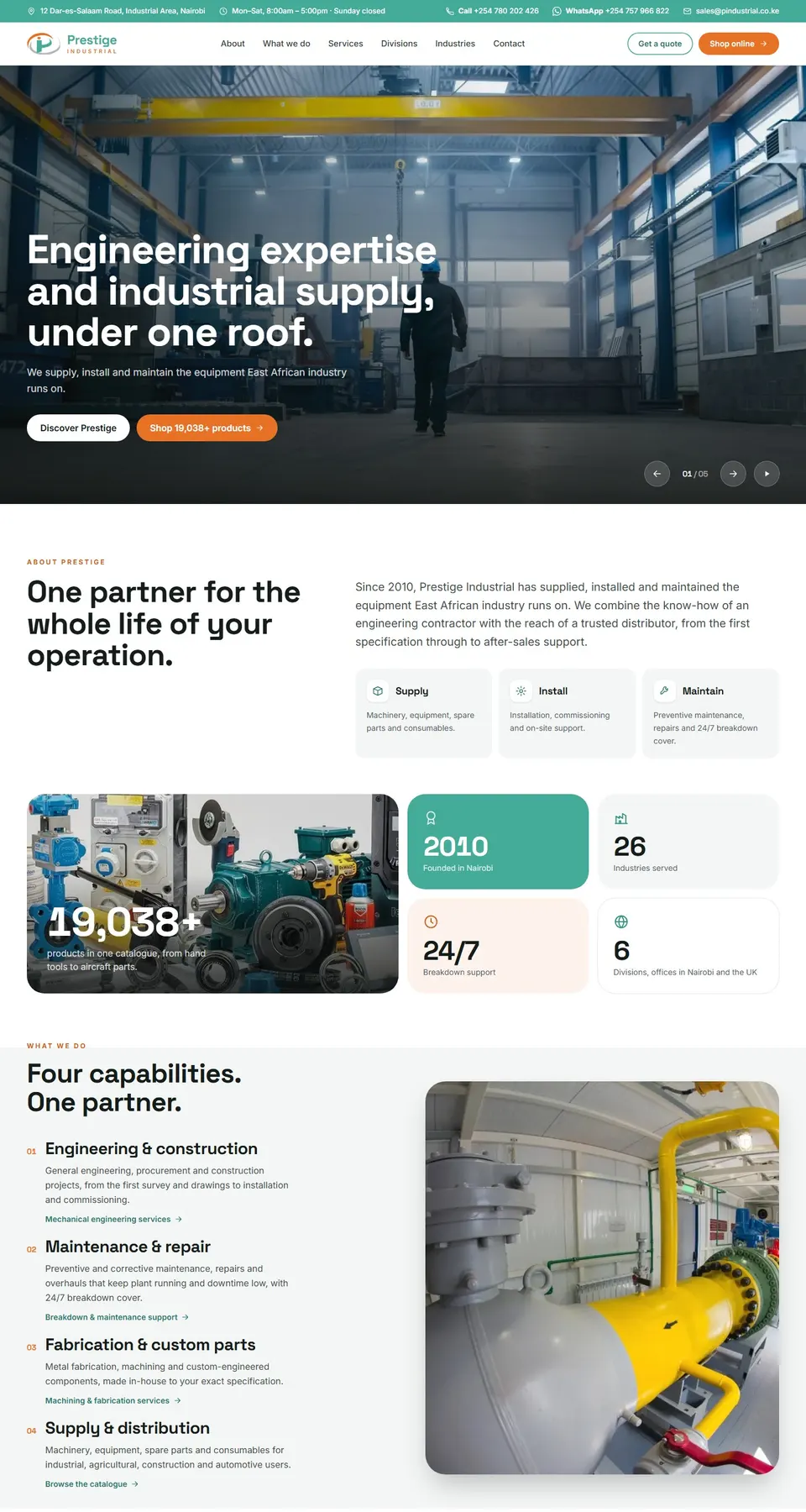 Prestige IndustrialIndustrial store
Engineering services and a 19,000-part industrial catalogue with quotes and online orders.
pindustrial.co.ke
Prestige IndustrialIndustrial store
Engineering services and a 19,000-part industrial catalogue with quotes and online orders.
pindustrial.co.ke
 Garrett AfricaDistributor store
Official Garrett detector distributor for Kenya, Zambia and Tanzania, with catalogue and dealer sales.
garrett.africa
Garrett AfricaDistributor store
Official Garrett detector distributor for Kenya, Zambia and Tanzania, with catalogue and dealer sales.
garrett.africa
 Case study · Industrial & B2B
Garrett Africa
Digital expansion and distributor enablement for the world’s leading metal detection brand.
300%Increase in organic traffic65New distributor pipelines opened#1Ranking for "Gold Detector Africa"
Read the case study
Case study · Industrial & B2B
Garrett Africa
Digital expansion and distributor enablement for the world’s leading metal detection brand.
300%Increase in organic traffic65New distributor pipelines opened#1Ranking for "Gold Detector Africa"
Read the case study

Visible.
Orders, stock and cash on one screen, with problems flagged early.
Costed.
Every batch carries its true cost, from raw material to dispatch.
Built for Kenya.
Ready for M-Pesa and KRA eTIMS, with statutory payroll built in.
Everything inside
220 features. 25 areas, one system.
Every feature in Pinch for Manufacturing, grouped by area. Pick an area, or search for the thing you need.
AI insights
Problems the system spots in your own data: orders at risk, stock short of demand, overdue money, tired crews.
- Orders at riskEach open order compared with its stage targets and due date, and flagged when it is likely to ship late.
- Stock against demandOpen orders and the production plan set against stock and incoming LPOs, so a shortage shows days ahead.
- Overdue invoicesCustomers sliding past their terms, with the amount, the days overdue and the rep responsible.
- Staff overloadOvertime, back-to-back shifts and leave clashes picked up from attendance and the roster.
- Yield driftLines whose yield falls below the recipe standard over several batches, before it shows in the accounts.
- Customer concentrationA warning when one customer grows to a large share of sales or of the money owed to you.
- Supplier warningsLate deliveries, rejected loads and expiring compliance documents raised against the supplier.
- Plain explanationsEvery insight says what was found, why it matters and the figures behind it, with links to the records.
- Owner and follow-upAssign an insight to a person, add notes, and close it with what was done. It reopens if the problem returns.
- Your own alert rulesSet thresholds such as days of stock cover or weekly overtime hours, and choose who is told.
Approvals
One inbox for every approval, with value levels, maker-checker and a reason kept for each decision.
- One inbox for everythingPurchase requests, LPOs, payment runs, discounts, credit limits, stock adjustments, overtime and leave in one list.
- Value levelsEach approval type has its own value bands, so a KES 40,000 LPO and a KES 4M one go to different people.
- Maker-checkerThe person who raises a document can never approve it, and the system enforces it on every type.
- Approve from a phoneApprove, return or reject from the inbox on a phone, with the documents behind the request attached.
- Reasons keptReturns and rejections need a reason, which stays on the document's history for good.
- DelegationHand your approvals to a colleague while you are on leave, with start and end dates and a value cap.
- Override with a reasonThe managing director can lift a block, such as a credit hold, only with a written reason on record.
- Reminders and escalationApprovers reminded when an item waits too long, and moved to the next level after a set time.
- Rules you controlApproval types, levels, approvers and amounts set by an administrator, without a developer.
- Full trail for auditorsWho approved what, at which level and when, exportable to Excel for the auditors.
Production orders
Production orders on stage tracks with target days, risk flags, a kanban board and the line schedule.
- Stage tracks per productMaize meal goes through cleaning, conditioning, milling, fortifying, QA and packing; peanut butter through roasting to filling.
- Target days per stageEach stage has a target, and the order shows days used against days allowed at every step.
- Risk flagsOrders behind their stage targets or close to the due date turn amber, then red, before they are late.
- Kanban boardEvery open order as a card in its current stage. Move the card when the stage is done.
- Line scheduleOrders placed on lines by day and shift, with capacity per line and clashes shown.
- Orders from sales or stockRaised from a confirmed sales order, from a finished product's reorder level, or by hand.
- Digital job cardsRecipe, stages, checks and materials on a tablet at the line, signed off by the crew lead.
- Material issue by batchStores issue against the order by batch, and the order shows what is still to come.
- Output, by-products and wasteGood packs, bran and germ, and waste with a reason. Waste above tolerance needs approval.
- Rework queueBatches that fail QA go to a rework queue on their own job card, linked to the original order.
- Dryer and roaster readingsMoisture and temperature logged against the grain dryer or peanut roaster, with the target beside them.
- Job timeCrew hours per stage from the job time sheet, approved by the supervisor and costed to the order.
Recipes & yield
Versioned recipes and bills of materials, with a yield planner that works out inputs, losses and packing.
- Recipes with versionsIngredients, premix, packing and stages per product, with versions, effective dates and who approved each change.
- Multi-level BOMsA pack of porridge flour uses a blend, which uses milled maize, soya and millet, each costed at its own level.
- Yield plannerEnter the packs you need and get the raw material, expected losses, by-products and packing to issue.
- Loss allowances per stageCleaning, milling and roasting losses set per stage, so planned inputs allow for them.
- By-products valuedBran, germ and peanut skins planned and valued on the recipe, not written off.
- Fortification rulesPremix dose per tonne set on the recipe and checked at the fortifying stage.
- Packing BOMFilm, bale bags, jars, labels and cartons per pack size, so packing is ordered with the product.
- Allergens and nutritionPeanuts and soya flagged as allergens, and the nutrition panel kept with the recipe for labels.
- Approved substitutesAlternative ingredients with their own ratios, used only when the usual one is short.
- Standard cost roll-upRecipe cost recalculated from current prices, showing what each change does to the cost per pack.
- Batch sheet PDFA batch sheet with quantities scaled to the order, printed for the line or opened on the tablet.
Quality & food safety
Scored inspections, defects, non-conformance reports, corrective actions and customer complaints.
- Inspection plansChecks set per material and product: moisture, aflatoxin, foreign matter, fill weight, seal and label.
- Scored inspectionsEach inspection scored against its limits, and the score decides pass, hold or reject.
- Intake holdRaw material sits on hold at goods receipt until QA passes it, and held stock cannot be issued.
- In-process checksMoisture, particle size and premix checks at the line on the tablet, against the job card.
- Batch releaseA finished batch is released by QA before it can be sold, and a hold blocks picking at once.
- Inspection labelsPassed, hold and reject labels printed for pallets and bags at each check.
- Defect logDefects by type, line and shift, with photos, so a recurring problem is easy to see.
- Non-conformance reportsAn NCR for any failure, with the batch, quantity affected, root cause and decision.
- Corrective actionsActions with an owner and due date, checked for effect before the NCR can close.
- Customer complaintsComplaints logged against the batch number on the pack, investigated and answered within a set time.
- Certificates of analysisA certificate per batch with its results, attached to the delivery when a customer asks.
- Supplier qualityRejection rates and results per supplier feed the supplier scorecard.
Assets & maintenance
Asset register, planned maintenance, breakdown jobs, spares, calibration and an energy log per machine.
- Asset registerEvery mill, roaster, packer, generator and truck with location, value, supplier and warranty.
- Planned maintenanceService tasks by calendar or running hours, raised as jobs before they fall due.
- Breakdown reportingOperators report a fault from the line tablet, and the technician on duty sees it in the system and by email.
- Maintenance jobsJobs with tasks, technician, spares used, hours and cost, signed off when the machine runs again.
- Downtime trackingHow long each machine was down and why, set against the output it cost.
- Spares storeScreens, bearings and belts held as spares, issued to jobs and reordered at their minimum.
- Cost per assetLabour, spares and contractor costs per machine, to show which ones cost most to keep running.
- Energy logElectricity and generator diesel per meter, with energy cost per tonne produced.
- CalibrationScales, thermometers and moisture meters calibrated on schedule, with certificates kept for audits.
- DepreciationAsset values depreciated each month into the ledger, by class and method.
Inventory & batches
Stock in batches with QR labels and a public batch page, moving average cost, counts, valuation and reorder.
- Stock in batchesEvery receipt and production run is a batch, with its supplier or order, dates and test results.
- QR labelsPallets, bags and bins carry QR labels. Scan one with a phone to receive, move, issue or count it.
- Public batch pageThe QR code on a pack opens a page with the product, batch, dates and QA result for buyers to check.
- Trace and mock recallTrace a batch back to its raw materials and forward to every customer, and time a mock recall.
- Expiry and FEFO pickingPick lists send the earliest-expiring released stock first, and near-expiry stock is flagged.
- Moving average costEach item valued at moving average cost, updated by every receipt and every landed cost.
- Movements ledgerEvery receipt, issue, transfer and adjustment in one ledger, by item, batch and store.
- Stock countsFull and cycle counts on a phone, with variances valued and approved before they post.
- ValuationStock value by store, category and batch at any date, agreeing with the ledger.
- Reorder alertsMinimum and reorder levels per item. Anything below them goes onto the reorder proposal.
- Supplier-owned stockPacking film held on consignment for the supplier, kept apart and paid for only when used.
- Stores and transfersRaw material, packing, finished goods and depot stores, with transfers tracked while in transit.
Purchasing
Reorder proposals, requests, RFQs, local and import POs, GRNs with QA hold, landed costs and three-way match.
- Reorder proposalsItems below reorder level, plus what open production orders need, turned into a proposed buying list.
- Purchase requestsDepartments request materials, spares or services, approved by value level before anything is bought.
- RFQs, compare and awardQuotes from several suppliers side by side on price, terms and lead time, with the award and its reason kept.
- Local and import POsLocal LPOs in KES and import orders in USD with Incoterms, sent to the supplier as a PDF.
- GRN with inspection holdGoods received against the PO, weighed or counted, and held for QA before they can be used.
- Landed costsFreight, duty, clearing and insurance spread over an import's items, so stock carries its true cost.
- Three-way matchSupplier bills matched to the PO and the GRN. A price or quantity difference is held for review.
- Returns and debit notesRejected goods returned with a debit note, and the supplier's credit note matched when it arrives.
- GRNI ageingGoods received but not yet billed, aged by supplier, so month-end accruals are right.
- Request to payment chainOne view from the request through RFQ, PO, GRN and bill to payment, for any purchase.
- Budget checkEach request checked against its budget line, with spend to date shown to the approver.
- Partial deliveriesPOs received over several deliveries, with what is outstanding or late shown per line.
Suppliers
Supplier records with compliance documents, expiry alerts, verified bank changes and monthly scorecards.
- Supplier onboardingKRA PIN, registration, bank details and contacts captured and approved before the first order.
- Compliance documentsTax compliance certificates, licences and food safety certificates stored with their expiry dates.
- Expiry alertsProcurement told 30 days before a document expires. An expired one blocks new orders.
- Bank change verificationA new bank account is held until a call-back confirms it and a second person approves it.
- ScorecardsOn-time delivery, rejection rate, price against other quotes and RFQ response, scored each month.
- Approved items and pricesWhich supplier can supply what, at agreed prices and lead times.
- Supplier statementsBills, payments, debit notes and balance per supplier, reconciled with their statement.
- Supplier portalSuppliers see their POs, send quotes and documents, and check payments on a walled-off login.
- Holds with a reasonA supplier put on hold with a reason cannot receive a PO until the hold is lifted.
- One page per supplierEvery RFQ, PO, GRN, rejection, complaint and payment with a supplier in one place.
Customers & quotes
Customers on credit terms, quotes with a public link to accept and convert, and brokers with their commission.
- Customer accountsDistributors, supermarkets and institutions with contacts, delivery points, price list and rep.
- Credit terms and limitsTerms and a credit limit per customer, with the balance and ageing on their page.
- StatementsStatements by email at month end or on request, with invoices, receipts and credit notes.
- Lead boardNew trade leads from the website and Pinch CRM on a board, from first call to first order.
- Price listsPrices by channel, region and customer, with effective dates and approval for any change.
- Quote templatesStandard quotes for distributors, institutions and export, with the terms already filled in.
- Excel importPaste or import a buyer's list of products and quantities straight into a quote.
- Public quote linkThe customer opens the quote from a link, downloads the PDF and accepts it online.
- Convert to orderAn accepted quote becomes a sales order with its prices and terms carried over.
- Brokers and commissionsBrokers linked to the customers they bring, with commission worked out on what is paid, not invoiced.
- Follow-upsQuotes not yet accepted come back to the rep after a set number of days.
Orders & dispatch
Sales orders with credit checks, a dispatch board, routes, trucks, fuel, proof of delivery and returns.
- Sales ordersFrom an accepted quote, the customer portal or a rep, with stock reserved as soon as the order is confirmed.
- Credit-limit dispatch holdAn order that takes a customer over their limit or past due is held until paid or released by an approver.
- Pick by expiryPick lists pull the earliest-expiring released batch, and the batch numbers print on the delivery note.
- Dispatch boardOrders by day and route: ready, loading, on the road and delivered.
- Routes and loadsOrders grouped by route and loaded in drop order, with weight against each truck's capacity.
- Trucks and driversTrucks with their documents and service dates, and a driver roster by day.
- Fuel logFuel drawn per truck and trip, with kilometres and fuel cost per drop.
- Proof of deliveryThe customer signs on the driver's phone, and the photos, time and place stay with the delivery note.
- Short and damaged deliveriesDifferences found at the drop recorded there and then, and sent to sales and finance.
- ReturnsReturns authorised with a reason, received back by batch, inspected by QA and credited.
- Delivery notes and gate passesPrinted at loading and checked at the gate against what is on the truck.
Invoices & receivables
Invoices with eTIMS details, receipts, ageing, three-step reminders and credit-limit holds on dispatch.
- Invoice from the deliveryThe invoice is made from the signed delivery note, so what was delivered is what is billed.
- eTIMS details on every invoiceeTIMS invoice number and QR code kept with each invoice and credit note. Ready to connect to KRA eTIMS.
- Credit notesReturns, short deliveries and price corrections credited against the original invoice, with approval.
- ReceiptsM-Pesa, bank and cheque receipts allocated to invoices, with M-Pesa and bank lines matched from statement imports.
- Customer ageingBalances in 30, 60, 90 and over-90-day buckets, by customer, rep and route.
- Three-step remindersA friendly reminder, a firm one and a final notice by email as an invoice passes set days overdue.
- Credit-limit dispatch holdCustomers over their limit or past due have new deliveries held until they pay or an approver releases them.
- StatementsStatements by email at month end, or on request from the customer's page.
- Collections by repEach rep sees what their customers owe and what falls due this week.
- Commission on receiptsBroker commission worked out when the customer pays, ready for the next payment run.
- Bad debt provisionA provision worked out from the ageing, with write-offs approved before they post.
Job costing & margins
Every production order costed from materials, labour, energy and overheads, from WIP through to cost of sales.
- Job costing per orderMaterials at moving average cost, crew hours, machine time, energy and overheads collected on each order.
- WIP to cost of salesCosts sit in work in progress while the order runs, move to finished goods when it closes and to cost of sales when sold.
- Standard against actualEach order's cost set against the recipe standard, with the variance split into price, yield and labour.
- Cost per kilo and per packThe true cost of each pack size, from raw material to the packed bale.
- Overhead allocationRent, power, depreciation and supervision spread by machine hours, tonnes or labour hours.
- By-product creditsBran, germ and skins valued and credited, lowering the cost of the main product.
- Waste and rework costWhat waste, rework and rejected batches cost, by line and by reason.
- Margins everywhereSelling price less true cost for every product, customer, route and order, after delivery costs.
- Price simulationTry a maize price rise or a new selling price and see what it does to every product's margin.
- Month-end costing closeOpen orders valued as WIP and the month's costing posted to the ledger in one step.
Banking, tax & ledger
Payment runs with bank files, M-Pesa and bank reconciliation, VAT, withholding, the ledger, periods, budgets.
- Payment runsSupplier bills that fall due are proposed for payment, approved by level and paid in one run.
- Bank filesEach approved run exported as a bulk payment file for your bank, so no amount is typed twice.
- Statement importsBank statements imported in the formats of nine Kenyan banks, and M-Pesa statements from the portal.
- ReconciliationImported lines matched to receipts and payments by amount, reference and date. The rest wait for review.
- Petty cash and cashbookPetty cash floats, vouchers and top-ups, and a cashbook for every bank and M-Pesa account.
- VATOutput and input VAT worked out from invoices and bills, with the return figures ready to file.
- Withholding taxWithholding VAT and income tax applied where due, with the certificates tracked.
- Tax calendarDue dates for VAT, PAYE, withholding and instalment tax, with reminders before each one.
- Ledger and statementsChart of accounts, journals with approval, trial balance, P&L, balance sheet and cash flow.
- Periods and year-endMonths closed and locked after review, foreign currency revaluation, and the year-end close.
- Budgets against actualBudgets by cost centre and month, compared with actual spend as it posts.
- Assets and loansDepreciation runs, and loans with drawdowns and repayments, posted to the ledger.
HR & attendance
Attendance and rosters, overtime from clock-ins, leave, recruitment to exit, and discipline letters.
- Clock-in and attendanceStaff clock in at the gate terminal or on a phone, and lateness and absence show by line and shift.
- Shift rostersRosters for shifts A, B and day per line, with swaps and cover approved by the supervisor.
- Overtime from attendanceOvertime worked out from clock-ins against the roster, and approved before it reaches payroll.
- Casual workersCasuals registered with ID and phone number, booked by day and paid weekly.
- Leave with accrualAnnual, sick, maternity and paternity leave accrued monthly, requested and approved on a phone.
- RecruitmentVacancies, candidates, interviews and offer letters, from the request to the signed offer.
- Onboarding and probationStarter checklists, documents and probation reviews, with reminders before the end date.
- Discipline lettersWarnings and show-cause letters from templates, with the response and outcome kept on file.
- Training and skills matrixFood hygiene, forklift and first-aid training with expiry dates, and who can run which machine.
- Exits and clearanceResignations and terminations with a clearance checklist across stores, finance and IT.
- Self-serviceStaff see payslips, P9s, leave balances and attendance, and ask for corrections or advances.
Payroll
Staff and casual payrolls with PAYE, NSSF, SHIF, Housing Levy, NITA and HELB, P9s and bank or M-Pesa files.
- Payroll runsMonthly staff and weekly casual payrolls, checked against the last period before approval.
- Pay from attendanceDays worked and approved overtime come in from attendance, so nobody types hours.
- PAYE and reliefsPAYE at the current KRA bands, with personal and insurance relief applied.
- NSSF, SHIF and Housing LevyStatutory deductions at current rates, with the employer's share worked out too.
- NITA and HELBThe NITA levy per employee, and HELB deductions for staff repaying a loan.
- Returns ready to fileP10, NSSF, SHIF and Housing Levy schedules in the formats each portal accepts.
- P9 formsP9s for every employee at year end, also available in self-service.
- Bank and M-Pesa bulk filesNet pay exported as a bank bulk file, and casual wages as an M-Pesa bulk payment file.
- Payslips by emailPayslips emailed as PDFs and kept in self-service.
- Advances and staff loansSalary advances and loans recovered over the months agreed, with balances shown.
- Bonuses and final duesProduction bonuses and sales commissions from approved schedules, and final settlements when someone leaves.
Distributor & customer portal
Trade customers order, track and pay on their own login, without calling your office.
- Own login per customerEach distributor, wholesaler or institution signs in and sees only their own account.
- Order from their price listCustomers order at their own prices and see what is available before they submit.
- Order trackingStatus from confirmed to in production, loaded, on the road and delivered.
- Invoices and statementsInvoices with their eTIMS details, credit notes and statements to view and download.
- Pay by M-PesaPay an invoice or the whole balance to your paybill, matched from the M-Pesa statement.
- Returns and complaintsRaise a return or a quality complaint with photos and the batch number from the pack.
Floor tablets & phones
Screens built for the line, the store and the road, on the phones and tablets your team already has.
- Tablet job cardsLarge buttons and short steps, built for operators on a busy line.
- Scan to actScan a pallet, bin or batch QR label with the phone camera to receive, move, issue or count it.
- Floor display screensThe kanban board and today's targets on a screen on the factory wall.
- Driver appDrivers see their drops, capture signatures and photos, and record returns.
Staff self-service
Every employee has a login for their own pay, leave and attendance.
- Payslips and P9sEvery payslip and P9 to view and download, without asking HR.
- Leave on a phoneLeave balances, requests and approvals on a phone.
- Attendance correctionsA missed clock-in raised by the employee and approved by the supervisor.
- AdvancesSalary advance requests with the approval and repayment plan shown.
- Goals, reviews and lettersGoals, review results and letters issued to the employee, in one place.
Alerts & notifications
The right person hears about a problem while there is still time to fix it.
- Low stockPurchasing told when a material or packing item reaches its reorder point.
- Quality failuresQA and the production manager told when a reading falls outside its limits.
- Machine breakdownsThe technician on duty told in the system and by email as soon as a fault is reported.
- Morning summaryAn email each morning with yesterday's output, sales, cash and exceptions.
Roles & audit
Each person sees and does only what their job needs, and every change is on record.
- Roles from director to operatorReady-made roles such as operator, storekeeper, QA, rep, driver, accountant and director, all adjustable.
- Plant and store scopeStaff limited to their own plant, depot or store when you run more than one site.
- Audit trailEvery change logged with who made it, when, and the values before and after.
- Locked documentsPosted invoices, GRNs and closed batches cannot be edited, only reversed with a reason.
- Separation of dutiesThe person who raises a purchase or a payment cannot also approve it.
Reports & dashboards
The numbers a manufacturer runs on, from the shift report to the board pack.
- Executive dashboardOrder book, money in and out, supplier performance and critical orders on one page.
- Daily production reportOutput, yield, downtime and labour by line and shift, ready at the end of each shift.
- Finance homeTwelve months of cash, profit by month, ageing buckets, tax dates and the month-end close.
- Sales analysisSales by product, customer, rep, route and region, against target.
- Board packA monthly pack with the accounts, key figures and notes, exported to PDF.
- Export to ExcelEvery list and report downloads to Excel or CSV for your own analysis.
Integrations
Ready for the services a Kenyan factory already uses for money, tax and staff.
- M-PesaReady for Daraja paybill, STK push and bulk payments. Today M-Pesa statements are imported and matched.
- KRA eTIMSeTIMS details kept on every invoice and credit note, and ready to connect to eTIMS directly.
- Kenyan banksStatement imports for nine Kenyan banks, and bulk payment files for supplier runs and payroll.
- Accounting exportsJournals exported to QuickBooks, Zoho Books or Sage if your auditors prefer them.
- Pinch CRMLeads from Pinch CRM flow onto the sales lead board.
- Clock-in terminalsAttendance imported from fingerprint or face terminals at the gate.
Data import & setup
Your products, recipes, customers and opening balances moved in and checked with you before go-live.
- Spreadsheet importItems, recipes, customers, suppliers and employees imported from Excel templates, with errors flagged.
- Opening stock and balancesOpening stock by store and batch, and customer and supplier balances, loaded and reconciled.
- Your numbering and layoutsDocument numbers, invoice layouts, LPO terms and delivery notes set up to match how you work.
- Training on siteShort guides for each role, and training on site for the floor, stores, sales and finance.
Security & backups
Your data kept safe, private and recoverable, in line with the Data Protection Act 2019.
- Encrypted connectionsEvery page served over HTTPS, with passwords and keys stored encrypted.
- Daily backupsThe database and files backed up every day to a separate location.
- Personal data controlsAccess to staff and customer personal data limited by role, with exports and deletions logged.
- Hosted and supportedPinch hosts the system, keeps it updated and supports your team after go-live.
No feature matches that search. Ask us, we probably build it.


Rollout
Live in 21 working days.
A fixed plan you can hold us to: what happens on which working day, from the first walk-through to the day your team goes live.
01Walk the floor
Days 1 to 3
We map how orders, stock and money move today and agree which modules go first.
02Build in sprints
Days 4 to 15
Working screens to test every few days, tested with your real products and prices.
03Move your data
Days 16 to 18
Opening stock, customers, suppliers and balances imported and checked with you.
04Train and go live
Days 19 to 21
Floor, stores, sales and finance trained on site. We stay close through the first month end.
Before you ask.
What is Pinch for Manufacturing?
A manufacturing ERP built by Pinch Africa for Kenyan manufacturers: production orders on stage tracks, recipes, quality, stock in batches, purchasing, suppliers, sales, dispatch, costing, finance, HR and payroll in one system, with one approvals inbox.
How long does it take to get our plant live?
21 working days, from the first walk-through to go-live. Days 1 to 3 we map how you work, days 4 to 15 we build and you test, days 16 to 18 we move your data, and days 19 to 21 we train your team and switch on.
Do we have to replace everything at once?
No. Most factories start with production and stock, then add sales, finance and payroll. Each module works on its own and they all share the same data.
Can approvals follow our own levels?
Yes. Each approval type has its own value bands and approvers, the person who raises a document can never approve it, and every decision keeps its reason. An administrator can change the rules without a developer.
Does it work with KRA eTIMS?
Yes. Every invoice and credit note keeps its eTIMS invoice number and QR code, and the system is ready to connect to KRA eTIMS directly. Until that link is switched on, eTIMS records are imported and matched to each invoice.
Can the team use it on their phones?
Yes. Every screen works on a phone or tablet, so supervisors, sales reps and drivers update it where the work happens.
Can it connect to the tools we already use?
Yes. It is ready for M-Pesa, your bank and eTIMS. Today it imports M-Pesa statements and statements from nine Kenyan banks, exports bulk payment files, and sends journals to QuickBooks, Zoho Books or Sage if your accountant prefers them.
What does it cost?
It depends on the modules and the number of users. After a free scoping call you get a fixed-scope proposal in writing, so you know the price before we start.
Let's map your factory.
A free scoping call, then a fixed-scope proposal in writing.